

Sanganeri Print vs Block Print: What’s the Difference?

Sanganeri print vs block print: if you’ve ever scrolled through cotton kurta sets online, you’ve probably seen both terms used as if they mean the same thing. They don’t, and once you know the difference, shopping gets a lot less confusing.

Let me explain it the way I’d explain it to a friend.
So, what is Sanganeri print?
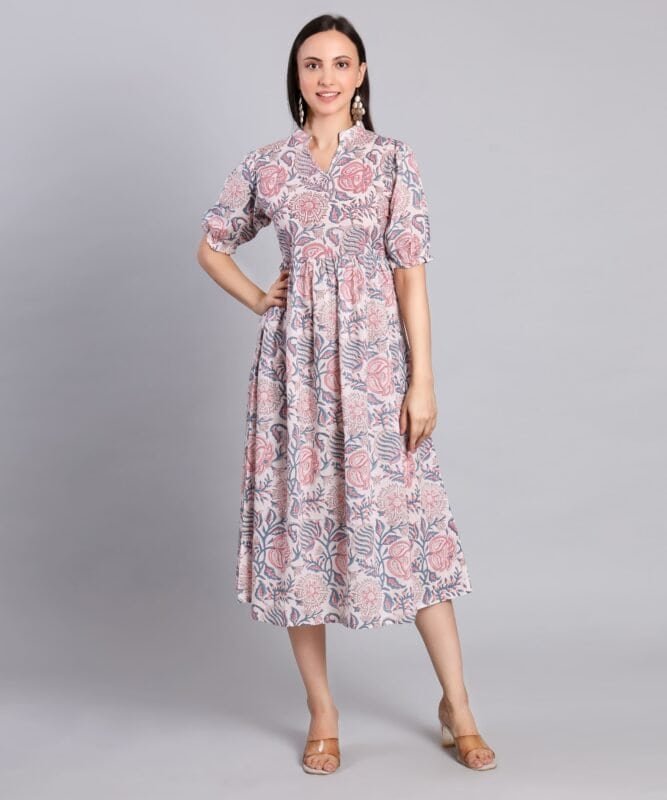
Sanganeri print takes its name from Sanganer, a town near Jaipur in Rajasthan. People know it for fine, delicate florals on white or off-white cotton, a look that has made it a long-time favourite for kurta sets.
According to the Incredible India portal, Sanganeri hand block printing goes back to the late 16th and early 17th century, when Chippa artisans migrated to Rajasthan, and it received a Geographical Indication (GI) tag in 2010. Traditionally, the prints were made by stamping with carved wooden blocks, which is why the two names often get mixed up.

And what exactly is block printing?
Here’s the simplest way to remember it: Sanganeri is a place and a style. Block printing is a method.
In block printing, an artisan dips a carved wooden block in dye and presses it onto the fabric by hand, again and again. Because a human hand places every stamp, you’ll see tiny differences in alignment and colour. Those little imperfections are the charm, not a flaw.
Artisans practise block printing in many other regions too, not just Sanganer.
Where does screen print fit in?
Makers also print some Sanganeri-style designs by screen printing. Here, the dye passes through a mesh screen that carries the pattern. The result is neater and more uniform, with sharper repeats and consistent colour, and it keeps prices friendlier.
One honest note: the GI tag is for Sanganeri hand block prints. A screen-printed piece is a Sanganeri-style design, not a handblock one, and a good seller will tell you which one you’re getting. At Etinika, our Sanganeri-style pieces are screen-printed cotton, and our handblock pieces are labelled as handblock. We state the print method clearly on every product page.
Sanganeri Print vs Block Print: How to Tell Them Apart
| Handblock | Screen Print | |
| Pattern repeat | Small natural variations | Very even and consistent |
| Motif edges | Soft, hand-stamped feel | Crisp and precise |
| Up close | Little imperfections are normal | Uniform throughout |
| Price | Usually higher | Usually more affordable |
A quick trick: look closely at the repeats. If every flower sits in a perfectly identical spot, it’s most likely screen printed. If you spot tiny shifts, it’s most likely handblock.
Sanganeri Print vs Block Print: Which One Should You Pick?
- Pick a block print cotton kurta set if you love the handmade character and don’t mind slight irregularities.
- Pick a Sanganeri-style screen print if you want the classic Jaipur floral look in a budget-friendly cotton kurta set for daily wear.
Neither is “better.” It depends on what you want from your outfit.
At Etinika, you’ll find both: Sanganeri-style screen prints and handblock prints. Browse our kurta sets, suit sets and dresses to see the difference in person, and check each product page, where we mention the print method clearly.
How to look after your cotton prints
- Wash separately in cold water for the first few washes.
- Turn the garment inside out before washing.
- Dry in shade, not in direct sun, so the colours stay fresh
Want the full guide? Read how to wash and care for a cotton kurta set so the print doesn’t fade.
FAQs
Is Sanganeri print the same as block print?
No. Sanganeri is a print style from Sanganer, Rajasthan. Block printing is a hand-stamping technique. Makers can print Sanganeri designs by block or by screen.
Which is better for daily wear?
Both are cotton and breathable. Screen print is more uniform and usually more affordable, so many people choose it for everyday use.
How can I check if a print is really handblock?
Look for small variations in motif alignment and colour. Perfectly identical repeats usually point to screen printing.


One thought on “Sanganeri Print vs Block Print: What’s the Difference?”